Characterizing charge and size variants of bispecific antibodies by icIEF fractionation and mass photometry
Created in collaboration with Bio-Techne
For bispecific antibodies (bsAbs), the analysis of charge and size variants is crucial for assessing both the correct pairing of monomers and the molecule’s stability. Pairing and stability are critical quality attributes (CQAs) that affect the biotherapeutic’s safety and efficacy. Conventional approaches typically involve charge variant fractionation by ion-exchange chromatography and size-variant analysis by size-exclusion chromatography (SEC). However, charge variant separation produces small, heterogeneous fractions that are incompatible with SEC, which requires large sample volumes and significant method optimization, including buffer exchange.
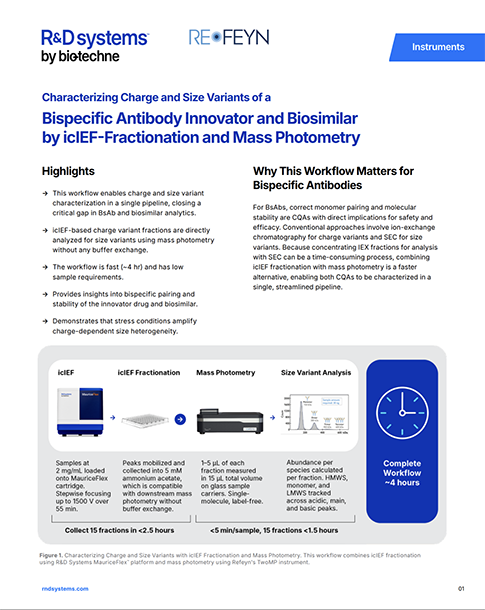
In this application note, we introduce a workflow that overcomes this challenge by combining imaged capillary isoelectric focusing (icIEF) fractionation technology from Bio-Techne with mass photometry (MP) from Refeyn. Using Bio-Techne’s MauriceFlex™ system and Refeyn’s TwoMP, the workflow takes just 4 hours and requires only 12 µg of sample.
We applied the workflow to analyze charge and size variants of the innovator bsAb Mosunetuzumab-axgb (Lunsumio) and a biosimilar under native conditions, heat stress, and forced aggregation. The analysis showed that biosimilar charge variants contain higher levels of both low-molecular-weight species (LMWS) and high-molecular-weight species (HMWS) compared to corresponding innovator fractions, revealing in detail how stress amplifies charge-dependent size heterogeneity.
This workflow closes a critical gap in bispecific antibody characterization. It enables the characterization of charge and size variants in a single, four-hour experiment, without any buffer exchange or method re-optimization. It supports faster development and earlier identification of quality issues.