
Refeyn will continue its role in a project that has received additional funding through the National Institute for Innovation in Manufacturing Biopharmaceuticals (NIIMBL), focused on intelligent optimization of adeno-associated virus (AAV) purification processes.
NIIMBL brings together academia, industry, and government to fund collaborative projects tackling shared challenges in biopharmaceutical manufacturing – with the goal of driving down costs and accelerating the adoption of new technologies across the sector.
Gene therapy is an important area where potentially significant clinical reach remains constrained by manufacturing cost and complexity. Isolating AAV vectors with the purity, potency, and safety profiles required for therapeutic use is technically demanding. While upstream expression systems are rapidly improving, purification remains a significant bottleneck, driving up development costs and limiting accessibility.
The project Refeyn is part of, Intelligent Affinity: Bayesian Optimization of Full AAV Purification Using Convective Affinity Adsorbents, aims to address this issue directly. By combining affinity membranes with a machine learning toolkit, it will build a comprehensive database of purification data across AAV serotypes. This would give developers a searchable resource to identify the best starting point for purification method development, reducing the time and resources spent on optimization.
Led by North Carolina State University, the consortium also includes ChromaGenix, EMD Millipore, Genentech, the University of North Carolina Chapel Hill, and Waters Technologies. It is one of eight projects awarded under NIIMBL’s Project Call 9.1, which allocated $9.7 million toward advancing domestic biopharmaceutical manufacturing.
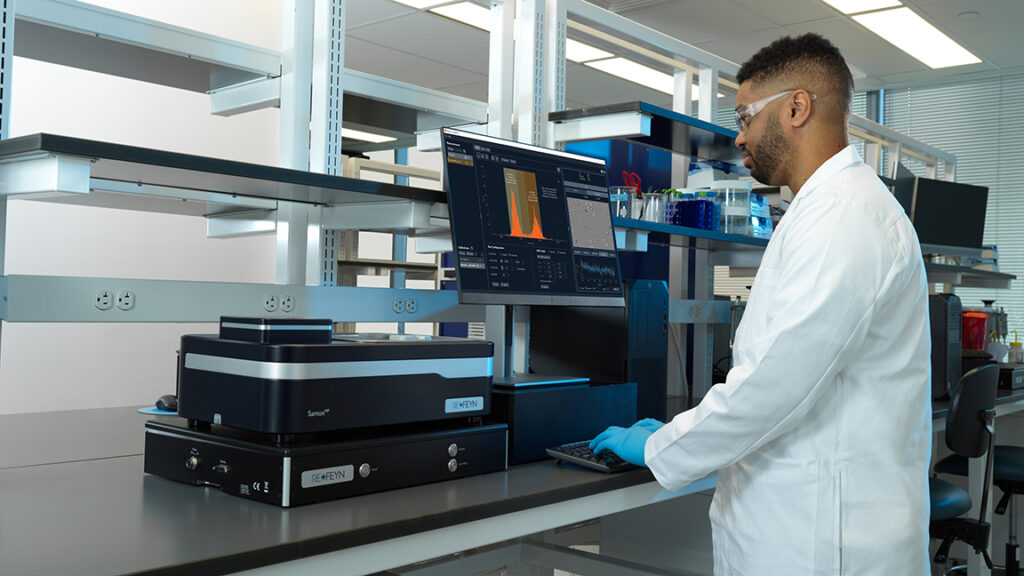
Refeyn’s Samux® mass photometer is contributing at-line process analytical capability to the consortium. AAV purification development has historically required significant sample volumes and time-intensive methods to characterize capsid populations across different serotypes. SamuxMP addresses this by quantifying empty, partially filled, full and overfilled AAV capsids in minutes, using minimal sample, and with single-particle resolution. It enables faster, more cost-effective optimization without compromising on the analytical quality needed to ensure product safety and potency.
Gabriella Kiss, Refeyn’s Director of Market and Applications Development, said:
“AAV purification development faces a real analytical challenge – you need to characterize capsid populations accurately across multiple serotypes quickly and without consuming a large amount of sample. Mass photometry is well placed to meet that need. Its speed and low sample requirements mean development teams can move faster and at lower cost, without sacrificing product quality or safety. Our consortium has made significant progress already, and I look forward to seeing what we can achieve in this next phase.”
The NIIMBL funding represents confidence in mass photometry from the biopharmaceutical manufacturing sector. This is reinforced by parallel recognition from regulatory authorities and international standards bodies. It signals the technique’s importance in AAV bioprocessing – and its value in standardized, harmonized approaches to AAV quality assessment.
Since 2024, mass photometry has been recognized by multiple authoritative bodies. Most recently, the ISO standard for Biotechnology – Gene Delivery Systems (16921-2) listed mass photometry as an approved method for determining AAV capsid content.
In 2025, the US Pharmacopeia (USP) referenced mass photometry in its USP general chapter <1067>, “Best Practices for the Manufacture and Quality Control of Recombinant Adeno-Associated Virus Gene Therapy Products”. The chapter highlights mass photometry – alongside AUC and TEM – as an orthogonal method capable of distinguishing between empty, full, and also partially filled capsids. USP also designated mass photometry as a key method for characterizing its new AAV reference standards.
Also in 2025, China’s National Institutes for Food and Drug Control endorsed mass photometry as a robust method for AAV characterization.
In 2024, the British Pharmacopeia included mass photometry in its Advanced Therapy Medicinal Products Guidance on Characterisation of the Capsid Particle Population in rAAV Products, describing it as a “viable option for at-line process monitoring.”