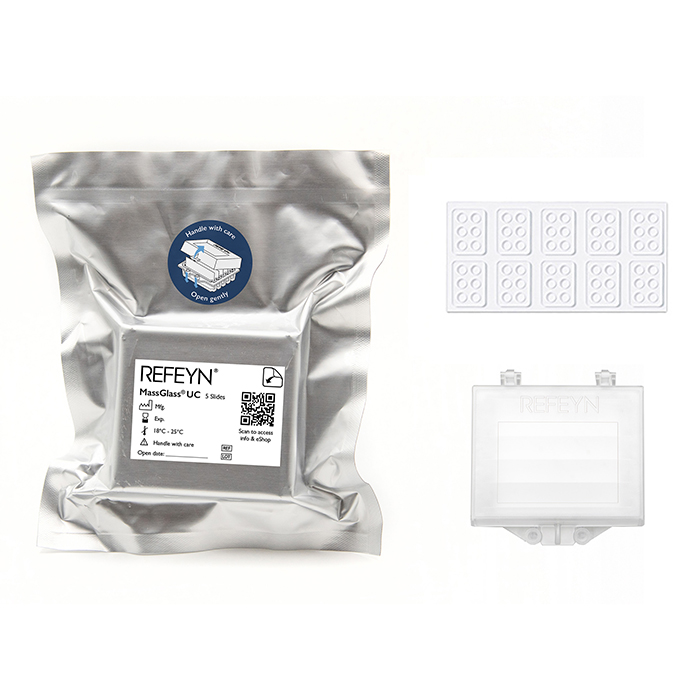
Refeyn’s MassGlass UC Sample Prep Kits are designed to deliver a high-quality sample interface for mass photometry measurements.
Each kit includes clean, uncoated glass slides and clean silicone cassettes, developed specifically for use with TwoMP and SamuxMP instruments.
Each kit allows up to 60 measurements and includes:
- 10 MassGlass UC ready‑to‑use uncoated sample carrier slides (2 boxes, 5 slides per box)
- 10 sample well cassettes (6 wells per cassette)
- 1 box of lens cleaning tissues (25 sheets)
Accurate mass photometry depends on biomolecules’ ability to interact with a clean and uniform glass surface. Contaminants or irregularities can lead to inconsistent data, particularly when measuring delicate molecules like proteins or complex particles like AAVs. The MassGlass UC slides provide a reproducible, uncoated surface out of the box—no pre-conditioning or surface preparation is needed. This ensures immediate usability and minimizes experimental variability.
Each slide is coupled with one clean silicone cassette using an alignment tool, creating a controlled environment that enhances measurement reliability.
The combination is optimized for:
- Proteins with molecular weights ≥50 kDa.
- AAV particles, allowing for robust analysis of capsid integrity, aggregation, and loading heterogeneity when used with SamuxMP.
Whether you’re conducting quantitative studies in gene therapy, protein complex formation, or quality control, MassGlass UC Sample Prep kits provide a high-quality and consistent surface with a level of convenience ideal for workflows in both academic and industrial labs.”
Please note: MassGlass UC slides have a defined shelf life—both from the date of manufacture and after opening—to ensure optimal performance.
For detailed guidance on storage, handling, and expiration timelines, please refer to the Product Data Sheet available in the Documents section.
Why should I not exceed the shelf life of the product?
Exceeding either the recommended shelf life or the shelf life after opening can lead to a decline in MassGlass UC performance. Over time, slides may accumulate increased background noise and more surface contamination, both of which can negatively affect the accuracy and reliability of your mass photometry measurements.
To ensure consistent data quality, Refeyn recommends using MassGlass UC within the defined usability periods provided for the unopened product and after the first opening. Beyond these limits, Refeyn cannot guarantee the validity of the results obtained.
Both the manufacturing date and the expiration date are clearly displayed on the MassGlass UC packaging label to help you track the appropriate usage window.
How can I achieve the best results with MassGlass UC for proteins between 30 and 50 kDa?
MassGlass UC slides are thoroughly cleaned and quality‑controlled to deliver reliable performance for particles above 50 kDa. Because mass photometry is extremely sensitive, samples between 30 and 50 kDa approach the natural detection limits of the technology, which can lead to increased background noise.
While some slides may already provide sufficiently low noise for measurements ≤50 kDa, achieving consistently optimal results in this mass range can require an additional manual cleaning step. We recommend hand‑cleaning the slide before your experiment using our simple, validated protocol.
Since the introduction of our new packaging in April 2026, customers can observed improved low‑mass noise performance, further enhancing reliability for measurements in the 30–50 kDa range.
To receive the detailed cleaning protocol or guidance for low‑mass applications, please contact your local Refeyn representative.
For optimal results, ensure the cleaning protocol is followed on MassGlass UC slides that are still within their shelf life.
Of note, no extra cleaning is required for SamuxMP measurements, or when measuring protein higher than 50 kDa on a TwoMP.
Can I reuse MassGlass UC and silicone well cassettes?
No, MassGlass UC and the silicone well cassettes are designed for single-use only to guarantee optimal results and avoid any sample or buffer cross-contamination, ensuring the best data quality is always obtained.