
Monitoring the assembly of 670 kDa, 16-mer complexes
Prof. Ross Larue’s lab used mass photometry and rapid-dilution microfluidics to gain the first-ever view of HIV intasome assembly
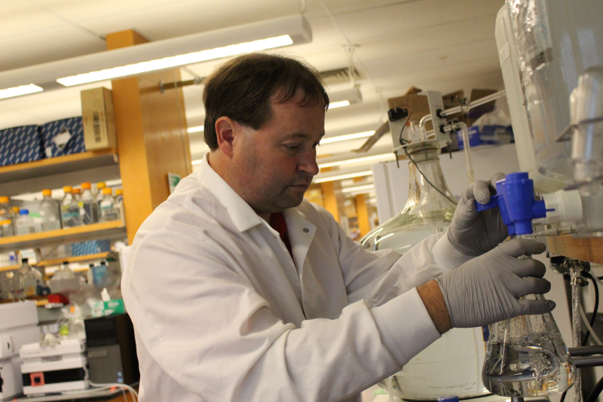
Ross Larue, Research Professor
The Ohio State University Center for Retrovirus Research
When SEC and TIRF fall short
Ross’s lab studies HIV and other retroviruses, focusing on how these viruses integrate into host genomes – and how the integration complex responsible, the intasome, assembles. Assembly intermediates could be new drug targets, which are urgently needed for a disease challenged by continually evolving resistance.
But studying that assembly quantitatively proved difficult with the tools available. Size-exclusion chromatography (SEC) lacked the size resolution to accurately identify and quantify intermediate complexes and couldn’t provide time-course data. Total internal reflection microscopy (TIRF) required concentrations so low that the complexes disassembled before they could be measured.
The HIV intasome is a 670 kDa, 16-mer complex that forms through monomeric, dimeric, tetrameric and octameric intermediates. To capture its formation, the lab needed a technique with single-molecule resolution that could keep samples at high concentrations (tens of micromolar) – so the assemblies would stay intact.
“We first explored mass photometry because the aim of our experiments was to determine how the HIV intasome forms by characterizing the complex over time, which we could not do with bulk techniques, like SEC, or single-molecule techniques like TIRF.”
Please don’t drill holes in your lid!
Ross has a strong relationship with Refeyn, having bought one of the first mass photometers ever produced. So when he got the idea to build a rapid-dilution device to enable mass photometry measurements at high concentration, he asked for a spare lid that he could drill holes into.
“They got back in touch the next day and said, ‘Please don’t drill holes in your lid!’ They told us that they were already working on something like that and asked if we would like to test the prototype.”
The group went on to become testers of what became the MassFluidix® HC rapid-dilution microfluidics system, providing feedback that helped shape its development.
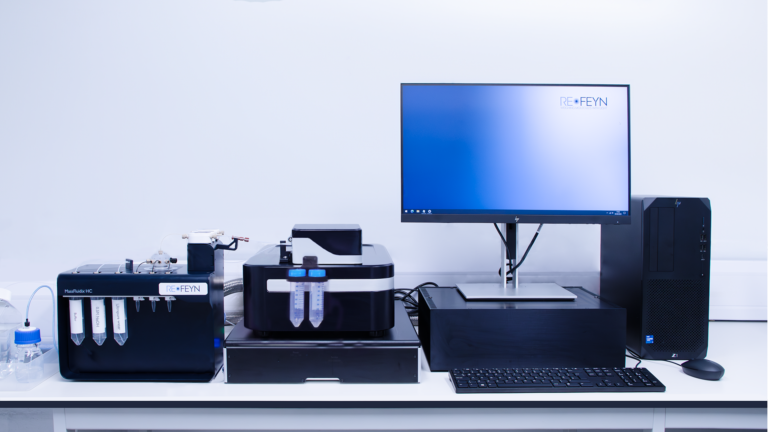
The MassFluidix HC system enables rapid dilution of highly concentrated samples.
Catching assemblies in the act
Applying mass photometry combined with rapid-dilution microfluidics to the assembly of large, multimeric HIV intasomes, Ross’s group was able to:
- Show that assembly is an ordered, gradual process
- Identify stable intermediates – potential new drug targets
- Gain insights for building smaller, simpler complexes that mimic HIV integration, enabling biochemical studies
- Observe the process across multiple time points – providing the most comprehensive view to date
“Using mass photometry and the MassFluidix HC system gives us that control where we can track over time and see ‘now it’s this size’, ‘now it’s broken down to tetramers’, ‘now it’s dimers’. It’s more kinetic than we could be with any other technique.”
The results challenged prevailing assumptions. Rather than assembling randomly, the intasome follows an ordered, stepwise process – which Ross expects will be “eye-opening to a lot of people” when the paper is published.
Early results are available in the application note, Revealing retroviral integration complex assembly with mass photometry and MassFluidix™ HC.
A tool with many uses
The group bought their mass photometer after they saw how well it worked on intasome samples, but now they use it routinely to check sample quality and purity, and screen mutations.
“Mass photometry has been a really cool, rapid way to screen mutations so we could mimic HIV integration with a much smaller complex. Rather than having to analyze all the mutants with cryo-EM, we can use MP to quickly see which oligomer sizes they form, and then just solve the structure for the best – it saves grad students and postdocs a lot of time.”
Ross also makes the instrument available to neighboring groups, and loves how adaptable and user-friendly it is.
“People from other labs come do experiments, and you can teach them the basics in 2 – 3 hours.”
He also continues to have a good relationship with Refeyn.
“No other company I’ve interacted with is as available and helpful as Refeyn. They are happy to answer any general question or stop by, and can get online almost immediately. Refeyn’s connection with its customers is a huge selling point.”

Ross Larue
Research Professor
Organization
The Ohio State University Center for Retrovirus Research
Application
Characterizing the assembly of large, multimeric complexes
Instruments
OneMP Mass Photometer
Location
Columbus, Ohio, USA
Users' bitesize insights on mass photometry
Related products & resources
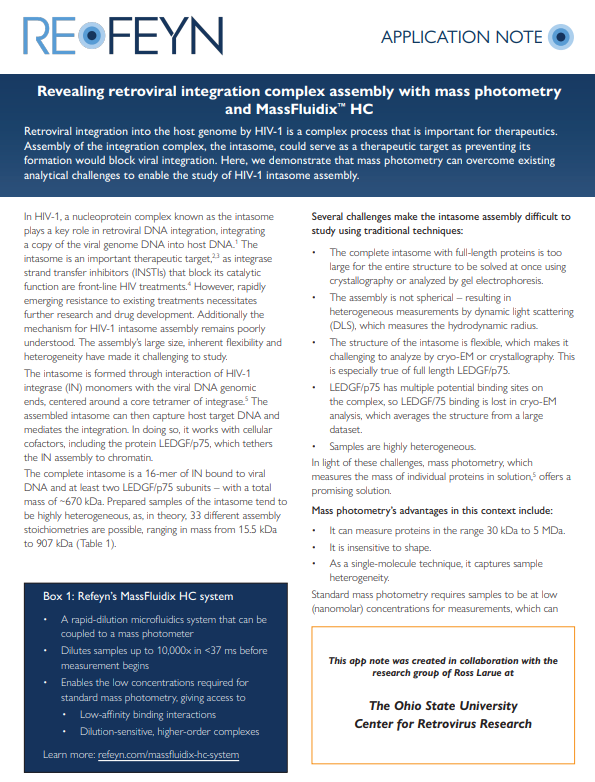
Revealing retroviral integration complex assembly with mass photometry and MassFluidix™ HC
We demonstrate that mass photometry, used in combination with the MassFluidix™ HC microfluidics system, can overcome existing analytical challenges to enable the study of HIV-1 intasome assembly.
Understanding mass photometry handbook
Whether you’re new to the technique or looking to get more from your experiments, our handbook Understanding Mass Photometry is your essential guide.
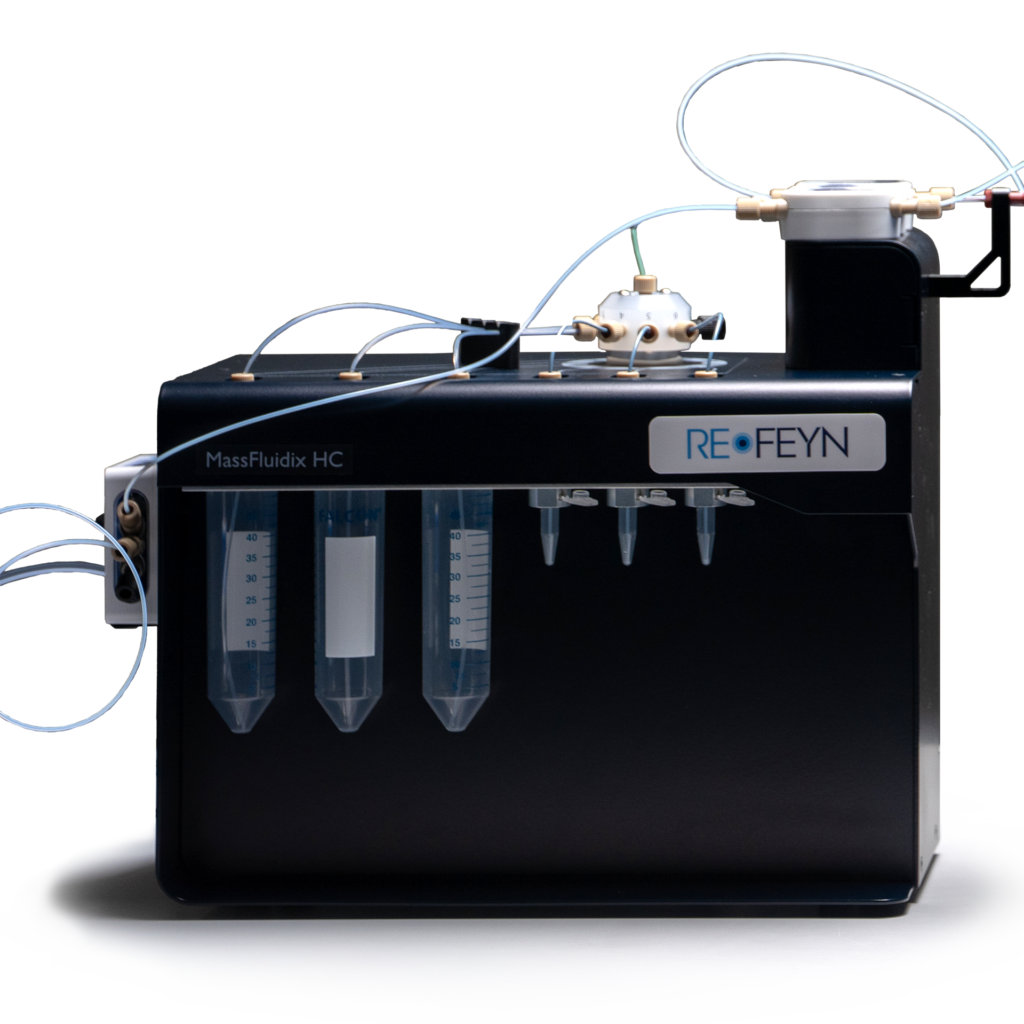
MassFluidix HC product family
Refeyn’s microfluidics system, MassFluidix HC, significantly expands the range of sample concentrations amenable to investigation by mass photometry, by raising the upper sample concentration limit from the nanomolar to the micromolar range. This enables applications such as the characterization of low-affinity interactions.
